El miedo del capitán Cacurcias
por José Carlos Andrés y Sonja Wimmer
edad: 8+
age: 8+
Este libro puede ser un poco difícil a leer para los niños porque hay algunas características del texto que no son normales. A veces el texto va en un circulo y a veces las letras no son iguales. Entonces, si su hijo/a está leyendo este libro puede mirar las páginas juntos antes de que lean el libro independiente. Es importante que su hijo/a sabe cómo leer el libro para comprenderlo.
Este libro se trata de un pirata que no tiene miedo de nada pero un día de repente, tiene miedo de todo. El se enfrenta con sus miedos y se da cuenta de que todos sus miedos son de su imaginación. Es un libro divertido y tiene dibujos creativos. En mi opinión puede enganchar a los niños con este cuento.
This book could be difficult for a child to read independently because it has some text features that are not always found in every book. Sometimes the text wraps itself around in a circle, sometimes the letters are not always the same. It would be a good idea to sit down with your child before they read the book and talk about how to read some of these text features.
This book is about a pirate who is not afraid of anything until one day he seems to be afraid of everything! He has to confront his fears, and when he does, he realizes that his fears all come from his imagination. This book has very creative drawings and can captivate the reader. I think this would be a very engaging book for kids.
Hoy estoy triste
por Clara Peñalver y Nune Martinez
edad: 7-8+
age: 7-8+
Este es otro de mis cueentos favoritos que he encontrado. Se trata cómo se siente Tuno, un niño, después de que se murió su mascota. Tuno es triste y llora en la escuela; otro niño se burla de él, entonces Tuno piensa que no puede estar triste en la escuela. La maestra y sus padres hablan con él en cómo manejar la tristeza. Es un libro lindo que puede ayudar a los niños manejar sus sentimientos. Habla de una metáfora para los sentimientos que a mi me gusta.Dice que cuando nos sentimos triste, aparece un globo en nuestra barriga. Si no hacemos nada con nuestros sentimientos, el globo va a inflar más y más hasta que se explote. Sin embargo, si hablamos de nuestros sentimientos, el globo va a desinflar.Creo que esta es una manera bonita para usar con los niños. Al final, hay una página escrito por un psicólogo con consejos para los padres.
This is one of my favorite stories that I have come across so far! This book is about Tuno, a little boy, whose fish passed away. Tuno is very sad and he cries at school; another student makes fun of him for crying and Tuno believes that it is not okay to be sad at school. His teacher and his parents talk to him about how to deal with his sadness. This is such a sweet story that can help kids learn to deal with their feelings of sadness. The author uses the metaphor about a balloon in our stomachs that make us feel sad. If we keep on holding in our feelings, the balloon will get bigger and bigger and eventually explode; however, if we talk about our feelings and let them out, the balloon will deflate. I think this is such a nice way to explain this! At the end of the book there is a page written by a psychologist to help parents help their children.
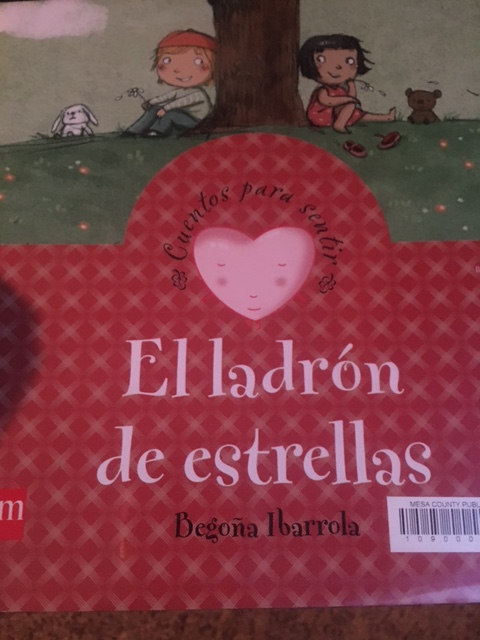
El ladrón de las estrellas
por Begoña Ibarrola
edad: 7-8+ (pero es ideal como lectura en voz alta para cualquier edad)
age: 7-8+ (great for a read aloud for all ages)
Una cosa importante para notar es que este libro tiene letras pegadas (cursiva) y puede ser difícil leer si su hijo/a no es familiar con estas letras. Este libro se trata de un niño quien está enamorado con una niña. Va a hacer cualquier cosa para enseñarle cómo se siente. Al final, él aprende que el mejor regalo que puede dar a otra persona es su corazón y siendo una buena persona. A mi me gusta este libro porque es un buen recordatorio que no siempre tiene que regalar algo sino el mejor regalo es siendo cómo eres de verdad.
One important thing to note about this book is that it is written in cursive and can be hard to read for kids who are not familiar with cursive writing. This book is about love and a little boy who loves a little girl. He will do anything for her to show her how much he loves her. In the end, he learns that the best thing that you can give to someone is your heart and being a caring person. I like this book because it is a good reminder that you do not need to give someone gifts all the time, but the best thing to do is to be yourself.
Estudiar es duro
por Jennifer Moore- Mollinos
edad: 7-8+
age: 7-8+
*este libro sería un buen libro para leer en voz alta*
*this book would be a great read aloud*
Este libro se trata de un niño que sabe la importancia de estudiar pero tiene ganas de jugar. Los lectores pueden ver sus pensamientos y cómo cambia acerca de estudiar. A mi me gusta este libro porque habla de la persistencia y los beneficios de estudiar. Las ilustraciones también nos ayuda a entender los sentimientos del niño. A traves de este libro, puede tener una conversaciones de los hábitos de estudiar en su casa con su hijo/a.
Preguntele a su hijo/a:
¿Qué es algo difícil para ti?
¿Qué podemos hacer para que no sea tan difícil?
This book is about a little boy who understands how important it is to study but he really wants to play with his friends. We, as readers, get a look into his thought process and how he changes with studying. I like this book because it talks a lot about being persistent and the benefits of studying. The illustrations also help us to notice how he is feeling and how he changes throughout. This book is a great conversation starter about studying habits in your house and with your child.
Ask your child:
What is something that is hard for you?
What can we do so that it is not so difficult for you?
Cómo reconocer a un monstruo
por Gustavo Roldán
Nivel: 6-8 años
Level: 6-8 years old
Calificación: ❤❤❤❤
Rating: ❤❤❤❤
A mi me gusta este libro porque es simple pero chistoso. Tiene un sentido de misterio y suspenso. Es un buen libro para usar para practicar la fluidez porque las oraciones son simples y el vocabulario no es tan difícil. Hay opotunidades de practicar la expression. También, no es un libro muy largo.
Preguntele a su hijo/a:
¿Cómo sabes que es un monstruo?
¿Cómo puedes enseñar a alguien a reconocer a un perro, gato, dragón, (lo que sea)?
I like this book because it is simple yet funny. It has a sense of mystery and suspense to it that kids enjoy. This would be a good book to use to practice fluency because the sentences are simple and the vocabulary is not too difficult. There are many opportunities to practice expression too! Also, this book is not very long.
Ask your child:
How do you know that this was a monster?
How can you teach someone to recognize a dog, cat, dragon, (whatever else you want to add)?